Payment Methods in Egypt (2026): What Customers Prefer and What Your Business Should Offer
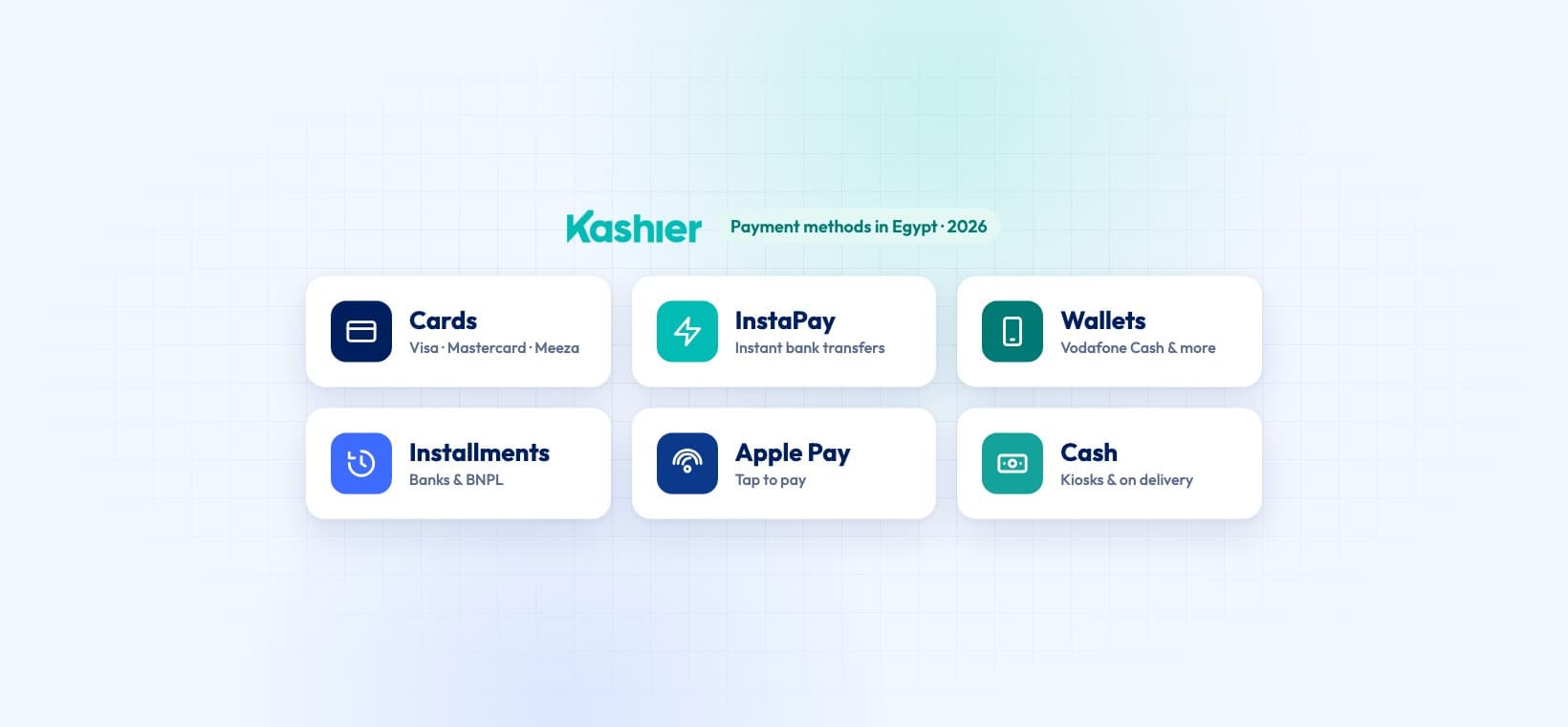
Egyptian customers no longer pay one way. The same shopper might pay for groceries with a Meeza card, send rent by InstaPay, top up a Vodafone Cash wallet at a kiosk and split a new phone into installments, all in the same week. If your checkout offers only one or two of these, some customers will leave rather than switch. This guide covers the payment methods Egyptians use in 2026, with the latest official numbers, which methods matter most for each type of business, and how to offer them all from one checkout.
The short answer
- Cards are the base. Visa, Mastercard and the national Meeza scheme work online, in store and through Apple Pay. Every business should accept them.
- InstaPay and mobile wallets are now mainstream. InstaPay has more than 24 million users, and Egyptians hold about 67 million mobile wallets.
- Installments decide big purchases. Consumer finance reached EGP 96.3 billion for 10.8 million people in fiscal year 2025.
- Cash is shrinking but not gone. Cash on delivery and kiosk payments still matter for customers without cards.
- The best checkout offers a mix: cards, wallets, InstaPay, installments and a cash option, in one place.
Egypt's payment picture in 2026, by the numbers
Digital payments in Egypt have grown fast. These are the latest figures from the Central Bank of Egypt (CBE), the National Telecom Regulatory Authority (NTRA) and the Financial Regulatory Authority (FRA).
| Indicator | Latest figure | Period | Source |
|---|---|---|---|
| Adults with a transactional account (financial inclusion) | 79% (56.4 million people) | June 2026 | CBE |
| InstaPay registered users | More than 24 million | September 2026 | CBE |
| InstaPay transactions in 2026 | More than 2.4 billion, worth about EGP 7 trillion | January to September 2026 | CBE |
| Mobile wallets (bank and telecom) | About 67 million | September 2026 | CBE |
| Telecom mobile wallet transactions | 2.22 billion, worth EGP 2.96 trillion | First half of 2026 | NTRA |
| Meeza cards issued | More than 43.5 million | June 2025 | CBE |
| Credit cards | About 6.7 million, up 61% in four years | June 2025 | CBE |
| Point-of-sale terminals | More than 1.4 million | March 2026 | CBE |
| Consumer finance | EGP 96.3 billion for 10.8 million customers | Fiscal year 2025 | FRA |
Two things stand out. First, most adults now have an account they can pay from, so the question is less "can my customer pay digitally?" and more "which method do they reach for first?". Second, the fastest growth is in InstaPay and wallets, the methods that don't need a card at all.
1. Cards: Visa, Mastercard and Meeza
Cards are still the backbone of online and in-store payments. Egypt's bank cards fall into three groups: debit cards linked to a bank account, prepaid cards (including many Meeza cards and payroll cards) and credit cards. Meeza is Egypt's national card scheme, and more than 43.5 million Meeza cards had been issued by June 2025.
Credit cards are a smaller group, about 6.7 million, but they matter for higher-value purchases, because card holders can split them through their bank's own installment plans.
What it means for you: accept Visa, Mastercard and Meeza at minimum. If you sell to tourists, expatriates or companies, American Express matters too. If you sell abroad, make sure foreign cards are accepted.
2. InstaPay: instant bank transfers
InstaPay, run on the CBE's Instant Payment Network, lets people send money from their bank account to another account, wallet or card in seconds. It has become the default way Egyptians send money to each other, and more and more people use it to pay businesses too. By September 2026 it had more than 24 million users and had processed more than 2.4 billion transactions that year.
Since April 2025, senders pay a fee of 0.1% per transfer (at least EGP 0.50 and at most EGP 20), which has not slowed growth.
What it means for you: many sellers still ask customers to send an InstaPay transfer and a screenshot, then check their bank app by hand. That works for a few orders a day, but it breaks as you grow: payments go unmatched, screenshots can be faked, and nobody knows which order was paid. Accepting InstaPay through your payment gateway ties each payment to an order and shows it in your dashboard automatically.
3. Mobile wallets: Vodafone Cash and others
Mobile wallets let people store and pay money from their phone number, without a bank card. Telecom wallets such as Vodafone Cash, Orange Cash and others reached 57 million wallets and 2.22 billion transactions in the first half of 2026, according to the NTRA, up from 46.3 million wallets a year earlier. Counting bank wallets as well, the CBE puts the total at about 67 million.
Wallets suit customers who don't have a bank card, or who are paid in cash and top up at a nearby shop.
What it means for you: if your customers are mass-market, outside Cairo and Alexandria, or younger, wallets can be the method that saves the sale. Offer them alongside cards, not instead of them.
4. Installments and Buy Now, Pay Later
For higher-value purchases such as electronics, furniture, courses, medical procedures and travel, Egyptian customers often decide based on whether they can pay in installments. There are two kinds:
- Bank installments: credit card holders split a purchase over months through their bank's program.
- Buy Now, Pay Later (consumer finance): customers without credit cards get approved by a licensed provider such as valU, Souhoola, Aman or Contact and pay monthly.
The FRA reports that consumer finance reached EGP 96.3 billion for 10.8 million customers in fiscal year 2025, up 57%, with 48 licensed companies. Financing in the first half of 2026 alone was up 88.5% on the year before.
What it means for you: if your average order is a few thousand pounds or more, show installment options clearly, on the product page and at checkout. Read more in our guide to Buy Now, Pay Later.
5. Apple Pay and contactless
Apple Pay launched in Egypt in December 2024 with National Bank of Egypt, Banque Misr and CIB, for Mastercard and Meeza cards. By June 2025 it had handled more than 40 million transactions worth more than EGP 32 billion, according to the CBE. Contactless tap-to-pay on cards and phones is now normal at shops and restaurants, helped by more than 1.4 million POS terminals across the country.
What it means for you: Apple Pay is the fastest checkout on iPhone, which makes it valuable for mobile shoppers and premium brands. In store, use terminals that accept tap-to-pay from cards and phones.
6. Cash, kiosks and cash on delivery
Cash is shrinking but still part of daily life. Cash on delivery remains common in e-commerce, especially for first orders from a new store, and kiosk networks let people pay bills and online orders in cash at a nearby shop. Fawry alone reported about 55 million active customers on its network in 2025.
Cash on delivery has real costs for sellers: refused orders, couriers carrying cash, and money that reaches you days later. Many stores keep it as an option but encourage digital payment, for example by offering free shipping or a small discount for paying online.
What it means for you: offer a cash option if your customers expect it, ideally a kiosk payment that is confirmed before you ship, rather than cash on delivery.
Which payment methods should your business offer?
The right mix depends on who your customers are and what they buy. Here is a starting point.
| Business type | Must have | Strongly recommended | Nice to have |
|---|---|---|---|
| Online store (fashion, beauty, gifts) | Cards incl. Meeza, wallets | InstaPay, Apple Pay | Installments, kiosk cash |
| Electronics, furniture, big-ticket retail | Cards, installments and BNPL | Wallets, Apple Pay | InstaPay |
| Schools, universities and courses | Cards, wallets | InstaPay, installments | Kiosk cash |
| Clinics, doctors and other professionals | Cards, payment links | Wallets, InstaPay | Installments for larger treatments |
| Restaurants, cafés and shops | POS with tap-to-pay, Meeza | Wallets and QR | Apple Pay on the terminal |
| Subscriptions and memberships | Cards with saved-card billing | Wallets | InstaPay for annual plans |
| Selling to customers abroad | International cards | Apple Pay | Prices shown in the customer's currency |
A quick checklist for your checkout
- Accept Visa, Mastercard and Meeza, online and in store.
- Add at least one mobile wallet option and InstaPay.
- Show installment options if your average order is high.
- Turn on Apple Pay for mobile shoppers.
- Keep a cash option only where customers need it, and prefer payments confirmed before you ship.
- Make sure every payment, whatever the method, lands in one dashboard and one settlement, so your finance team isn't matching screenshots.
How Kashier helps you accept them all
Kashier gives you one checkout for the methods Egyptian customers use: Visa, Mastercard, American Express and Meeza cards; mobile wallets such as Vodafone Cash; InstaPay; Apple Pay; cash collection at Basata kiosks; and installments through bank programs and partners such as valU, Souhoola, Aman and Contact. You can use the same methods on your website, in your app, through payment links sent on WhatsApp, and on POS machines in store.
- Clear pricing: online card payments cost 2.75% + EGP 3 per successful transaction, with no setup or monthly fees. See pricing, or read our comparison of payment gateways and fees in Egypt.
- Fast settlement: choose instant, same-day, next-business-day or a custom cycle, with gross, fees and net shown for every settlement.
- Customers abroad: accept cards from any country and show prices in the customer's currency, while you are settled in Egyptian pounds.
See every method in Kashier's online checkout, or talk to our sales team about the right mix for your business.
Frequently asked questions
What is the most popular payment method in Egypt?
For online shopping, cards (including Meeza) and mobile wallets are the most widely used digital methods, while InstaPay has become the most common way to send money between people. Cash on delivery is still common for first-time e-commerce orders, but its share is falling.
Can my customers pay with InstaPay on my website?
Yes, if your payment gateway supports it. With Kashier, InstaPay sits in the same checkout as cards and wallets, and each payment is matched to its order automatically.
Do I need to offer installments?
If you sell items worth a few thousand pounds or more, installments often make the difference between a sale and an abandoned cart. Bank installments serve credit card holders, and BNPL providers serve customers without credit cards.
Is Apple Pay available in Egypt?
Yes. Apple Pay launched in Egypt in December 2024 with National Bank of Egypt, Banque Misr and CIB for Mastercard and Meeza cards, and businesses can accept it online and on contactless terminals.
Can I accept payments from customers outside Egypt?
Yes. Kashier accepts cards, wallets and Apple Pay from any country, and you can show prices in USD, EUR, GBP and other currencies. Settlement is in Egyptian pounds to your bank account in Egypt.
Sources
- Financial inclusion, June 2026: CBE, reported by Ahram Online.
- InstaPay users and transactions, and total mobile wallets, September 2026: CBE, reported by Ahram Online.
- InstaPay transfer fee from April 2025: Egyptian Streets.
- Telecom mobile wallets, first half of 2026: NTRA, reported by Arab Finance.
- Meeza cards and Apple Pay transactions, June 2025: CBE, reported by Daily News Egypt.
- Credit cards, June 2025: CBE data, reported by Arab Finance.
- POS terminals, March 2026: CBE Financial Stability Report, reported by Bankygate.
- Consumer finance, fiscal year 2025: Financial Regulatory Authority; first half of 2026: Zawya.
- Apple Pay launch: Mastercard.
- Fawry active customers, 2025: Fawry earnings presentation.
Ready to put this into practice?
Talk to our team about collecting, operating and moving money on Kashier — online, in store and through your systems.
Talk to Sales